

The UAE work visa processing time is the total time it takes for a worker to move from employer approval to legal employment status in the UAE. It usually includes work permit steps plus residency formalities such as medical fitness and Emirates ID.
In 2026, the UAE work visa processing time can feel confusing because parts of the journey happen through different authorities and platforms. Your timeline can also change depending on whether you are applying in Dubai or another emirate and whether your employer is mainland or free zone.
This guide breaks down the work visa stages in plain language so employees and HR teams can estimate timelines, understand what causes delays and prepare documents correctly from day one.
When people ask about UAE work visa processing time, they are usually asking one of two things: how fast they can start working legally or how fast they can receive full residence status. In practice, the end-to-end journey is a sequence of approvals that must match across systems.
If you want the process handled with fewer back-and-forth corrections, working with an authorised government transaction partner like Arabian business center can help ensure forms and supporting documents are submitted with the right format and details.
What stages are included in UAE work visa processing time?
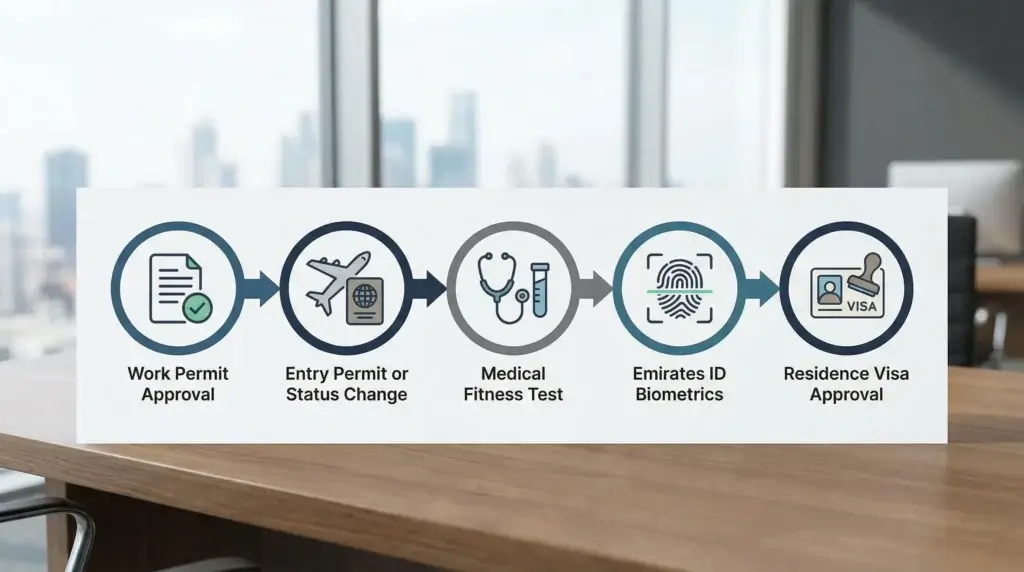
The full UAE work visa processing time generally includes:
- Work permit application and approval (often through MOHRE for mainland private sector roles)
- Entry permit issuance (if the employee is outside the UAE)
- Status change (if the employee is inside the UAE)
- Medical fitness test
- Emirates ID application and biometrics
- Residence visa approval and visa stamping confirmation (often linked to GDRFA in Dubai or ICP in other emirates)
A key point for 2026 is that the process is increasingly digital, but digital does not mean automatic. Data mismatches still trigger delays, especially name spelling, passport numbers, job titles and sponsor details.
Average UAE work visa processing time in 2026 (typical ranges)
For straightforward cases, the UAE work visa processing time is commonly measured in working days rather than calendar days. Weekends, public holidays, medical appointment availability and document readiness all affect the final timeline.
To make planning easier, here is a practical overview of a typical Dubai-focused workflow. These ranges are general guidance for 2026 and can vary by employer category, quota situation, security checks and document completeness.
| Stage | What it covers | Typical time (working days) | What can delay it |
|---|---|---|---|
| Work permit submission | Employer files job offer and work permit request | 2–7 | Incorrect job title, missing attachments, employer quota limits |
| Entry permit or status change | Entry permit for outside UAE or change of status inside UAE | 1–5 | Passport validity issues, unclear scans, pending approvals |
| Medical fitness | Medical test completion and result issuance | 1–3 | Appointment slots, re-test requests, data mismatches |
| Emirates ID biometrics | Biometrics appointment then processing starts | 2–10 | Missed appointment, biometric backlog, form errors |
| Residence visa approval | Final residency confirmation and visa stamping workflow | 2–7 | Unpaid fines, sponsor file issues, missing insurance where required |
| Estimated total | End-to-end for many standard cases | 8–32 | Any issue in earlier steps compounds |
This means the UAE work visa processing time may be as fast as a little over a week in ideal conditions but it can extend closer to a month for normal volumes.
Dubai vs other emirates: why timelines differ
In Dubai, parts of the residence stage often connect to GDRFA processes and Amer channels, while other emirates rely more heavily on ICP flows. If you are coordinating through a Typing Centre in Dubai you can also get help choosing the correct route for your case and ensuring submissions align with Dubai requirements.
From a planning perspective, your Dubai work visa timeline may look faster when appointments are readily available. In peak seasons, biometric slots and medical scheduling can become the bottleneck.
What makes UAE work visa processing time faster in 2026?
A major reason timelines improved in recent years is increased integration between platforms. In 2026, the best case scenario often happens when the employer has clean records, the employee documents are ready and submissions are made correctly the first time.
Some employers and applicants also benefit from streamlined initiatives. For example, the UAE has promoted bundled approaches that can reduce end-to-end cycles in some scenarios, as described in Work permit visa in 5 days. This does not apply to every case, but it shows how much time can be saved when steps are consolidated.
If your company is starting from scratch or hiring at scale, pairing internal HR with a reliable typing center helps keep the workflow consistent across multiple employees.
Common reasons UAE work visa processing time gets delayed
If your UAE work visa processing time is taking longer than expected, delays usually trace back to one of these categories:
Document and data issues
Even small mistakes can trigger rework.
- Different spelling between passport and application form
- Low-quality scans or cropped passport pages
- Missing attestations or translations where required
This is where using a specialist typing center dubai can reduce error rates because forms are reviewed before submission.
Authority routing and system queues
Work permits and residency steps are not processed by one single department. For mainland roles, the MOHRE work permit phase is a major piece of the employment visa processing time. For Dubai residency confirmation, GDRFA services can influence the residence approval stage.
You can review the official platforms here:
- MOHRE (work permits for many private sector roles)
- GDRFA Dubai (Dubai residency and entry permit services)
- ICP (federal residency and Emirates ID related services)
Medical and biometrics timing
Medical results are often quick, but scheduling can slow the process during busy periods. Emirates ID biometrics can also become the long pole, which directly impacts the UAE work visa processing time because later steps depend on earlier confirmations.
Practical tips to reduce UAE work visa processing time
If you are an employee, ask your employer for a checklist early. If you are HR, standardize your intake and validation.
One of the simplest ways to shorten UAE work visa processing time is to treat typing as a quality-control step, not just data entry. An experienced UAE typing center can validate documents, confirm the right submission channel (Amer services or Tasheel services where relevant) and reduce rejections.
Also confirm early whether your application will be handled as a standard employment visa processing time case or if it needs additional steps such as profession-specific approvals.
If you want to start with a clear, employer-friendly process, the work visa service page outlines how a structured workflow can keep documents aligned and avoid preventable delays.
Conclusion
In 2026, UAE work visa processing time depends on how quickly each linked stage moves: work permit approval, entry or status change, medical fitness, Emirates ID biometrics and final residence approval. The fastest outcomes usually come from accurate documentation, correct authority routing and early booking of medical and biometrics. For reliable assistance from an authorised Typing Centre in Dubai, you can contact us to help you submit correctly and track progress with fewer delays.
Frequently Asked Questions
The UAE work visa processing time in 2026 commonly ranges from about 8 to 32 working days depending on appointment availability, document accuracy and authority queues.
Yes. For many mainland private sector roles, MOHRE work permit approval is a major part of employment visa processing time and delays there will push the full timeline.
It can be. Dubai applications often follow GDRFA and Amer-related steps, while other emirates rely more on ICP processes, which can change the sequence and waiting times.
A typing center Dubai can help reduce UAE work visa processing time by preventing application errors, ensuring clean document scans and guiding the correct submission route.
The most common delay drivers in UAE work permit processing time are unclear passport scans, mismatched names, missing supporting documents and incomplete employer files.