
Dubai free zone visa rules and regulations are the official requirements that govern how a residency visa is issued, renewed or cancelled under a Dubai free zone sponsor. They cover who can apply, what documents are needed and which authorities must approve each step.
In 2026 these rules matter more than ever because most stages are now digital, data is cross-checked between portals and even small errors can create delays. This guide explains Dubai free zone visa rules and regulations from a practical angle, focusing on what founders, employees and dependents need to do to stay compliant.
You will learn how the process works in real life, which government channels are involved, what to prepare before you apply and how an authorised typing centre can help you avoid rejections.
What is a Dubai free zone visa in 2026?
A Dubai free zone visa is a UAE residence visa sponsored by a company or entity licensed in a Dubai free zone. Depending on your case it can be linked to an employment role, an investor or partner position or a dependent sponsorship under a free zone resident.
Dubai free zone visa rules and regulations differ from mainland sponsorship because the free zone authority plays a bigger role in approvals and quota management. That is why selecting the right jurisdiction at setup stage is important and the comparison in Mainland vs freezone business set up often becomes the first step before any visa planning.
Who manages free zone visas in Dubai?
Most Dubai free zone residence visas ultimately connect to Dubai immigration processes under GDRFA through authorised channels such as Amer. In parallel, your free zone authority typically controls establishment records, visa allocation and internal approvals.
For employment cases you may also deal with labour related steps depending on your free zone model and activity. When a process touches MOHRE related work permissions for mainland or specific arrangements, Tasheel channels may apply.
To understand the split, use this quick reference.
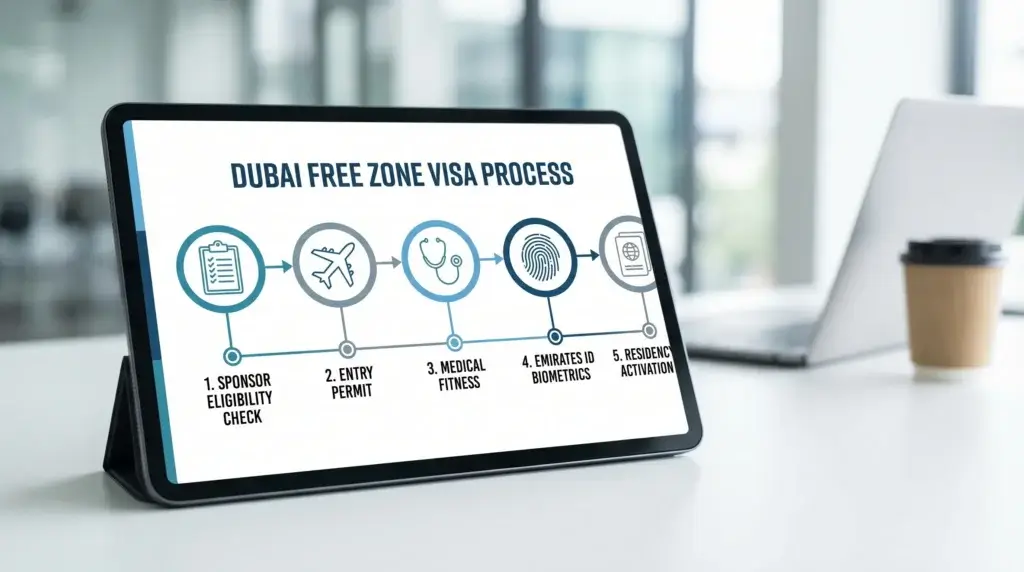
| Step in the Journey | Main Entity Involved | What You Receive or Confirm |
|---|---|---|
| Company eligibility and visa allocation | Free zone authority | Eligibility confirmation and visa quota availability |
| Entry permit or initial immigration submission | GDRFA and Amer channel | Entry permit approval status |
| Medical fitness stage | Dubai health system and approved medical centres | Medical fitness result |
| Emirates ID application | ICP system for Emirates ID | Emirates ID application tracking reference |
| Residency activation in Dubai immigration records | GDRFA | Updated residency status and e-visa confirmation |
Official portals to keep bookmarked in 2026 include GDRFA Dubai and ICP Smart Services plus MOHRE when your situation involves labour files.
Dubai free zone visa rules and regulations you must follow in 2026
Dubai free zone visa rules and regulations are not only about submitting forms. They are also about staying eligible before submission, matching records across systems and completing time-sensitive stages in the right order.
Rule 1: Sponsorship must match your role and licence
Your visa category must match the sponsor relationship on record. A free zone company visa is commonly used for owners, partners and employees under the free zone entity. A dependent file is used when a resident sponsors family.
If you are still finalising your licence structure, the business planning guidance in Setting Up a Business in Dubai helps you align your activity, office requirements and visa plan early.
Rule 2: Visa quota and facility compliance can block issuance
Visa availability in many free zones depends on factors such as licence package, leased space type and internal policies. Dubai free zone visa rules and regulations typically require that the sponsor has an active establishment record with no holds.
This is also where document consistency matters. If your company name or licence number appears differently across portals you can face a correction cycle before the visa moves forward.
Rule 3: Entry permit timing and in-country status must be correct
Dubai free zone visa rules and regulations require that the entry permit stage is used correctly based on your location.
If you are outside the UAE you generally enter on the relevant permit. If you are inside the UAE you may need a status change transaction rather than an exit. The correct option depends on current immigration status and the issuing system.
If you want to understand the digital filing flow before you start, the walkthrough on online visa application UAE explains how applications are submitted, paid and tracked.
Rule 4: Medical fitness and Emirates ID are not optional stages
Medical fitness is a standard part of most residence visa activations in Dubai. Emirates ID registration follows and ties your identity record to your residency. Any mismatch in passport details, name spelling or date formats can trigger verification requests.
This is why Dubai free zone visa rules and regulations are strongly tied to accurate typing and correct uploads.
Rule 5: Renewals and cancellations have strict sequencing
Renewals should be planned ahead of expiry so you have time for medical testing, Emirates ID steps and immigration approval. Cancellations should be completed properly before you switch sponsors or leave the UAE for long periods.
For Dubai residents, the step timing and channel choices are explained in the GDRFA visa renewal guide for UAE residents.
Dubai free zone visa process in 2026 (a practical workflow)
While each free zone has its own internal approvals, most applicants experience a similar Dubai free zone visa process once the file reaches immigration stages.
1) Pre-check your sponsor file and your personal data
Before submission confirm passport validity, photo quality and consistency of your name spelling across previous UAE records. Dubai free zone visa rules and regulations are increasingly enforced through automated data checks.
2) Confirm the right visa category
Choose the correct category for your case such as investor, partner or employee. A mismatch can cause a return for correction.
3) Prepare the entry permit submission
Your free zone authority or authorised channel submits the entry permit request. For many Dubai cases this step routes through GDRFA and authorised Amer channels.
4) Complete medical fitness and Emirates ID biometrics
After the permit stage you complete medical testing then proceed to Emirates ID biometrics when required. Delays often happen when appointments are missed or documents are uploaded in the wrong format.
5) Residency activation and record updates
Once approvals are complete your residency status is updated in the system. Keep copies of all confirmations and track your Emirates ID delivery status.
Dubai free zone visa rules and regulations do not end at approval. Ongoing compliance includes keeping your Emirates ID valid, maintaining your sponsor relationship and avoiding overstays if your status changes.
UAE free zone visa requirements: document checklist
Exact UAE free zone visa requirements vary by free zone and applicant type. Still, the following items are commonly requested for a free zone residence visa file.
- Passport copy with clear MRZ lines
- Recent personal photo that meets UAE standards
- Entry status evidence if you are in the UAE (such as visit visa details)
- Sponsor documents for the free zone company visa (licence copy and establishment details as applicable)
- Signed offer or employment documents when required
- Attested and translated documents when the authority requests them (for example relationship documents for dependents)
- Medical fitness completion evidence when requested
- Emirates ID application reference
Dubai free zone visa rules and regulations place heavy weight on document clarity. Low resolution scans or cropped pages are a top cause of delays.
Common issues that slow down approvals in 2026
Most delays are avoidable when you treat Dubai free zone visa rules and regulations like a data accuracy project not only a paperwork task.
Data mismatch across systems
Even a small difference in spelling can create a hold until the record is aligned. This includes passport renewal updates that were never reflected in old UAE files.
Wrong jurisdiction or channel
Dubai applications should follow Dubai routing. If a submission is made through the wrong portal it can be rejected or stuck until refiled.
Incomplete dependent documentation
Dependent applications often need certified translation or attestation depending on where the documents were issued. Submitting without the required legalisation leads to repeated corrections.
Late renewal preparation
Medical testing and Emirates ID steps take time. Start early so you do not end up with an expired status while waiting for appointments.
Dubai free zone visa rules and regulations are designed to be predictable but only when each step is completed in order.
When to use an authorised typing centre for free zone visas
Many applicants can start parts of the process online but an authorised centre is valuable when you want the file submitted correctly the first time. Working with an approved typing partner helps you avoid avoidable returns for correction.
At Arabian business center clients use a single team for document checking, accurate submission and status follow-up across key channels.
If you prefer assisted handling in person or through courier support, a trusted Typing Centre in Dubai can also help coordinate Amer services, Tasheel services and DET services where applicable.
This is especially helpful when you are dealing with multiple transactions at once such as visa renewal, Emirates ID typing and document attestation. In those cases using a verified typing center reduces errors and keeps your timeline realistic.
Conclusion
Dubai free zone visa rules and regulations in 2026 come down to three priorities: correct sponsorship category, clean document and data consistency and on-time completion of medical and Emirates ID stages. If you face any difficulty in traveling or managing your visa process, Arabian Business Center is here to assist you seamlessly through our convenient online support services. Contact us today to get guided help with free zone visa submissions, tracking and corrections without unnecessary delays.
Frequently Asked Questions
Most cases require a valid passport, compliant photo, sponsor approvals from the free zone, entry permit processing, medical fitness and Emirates ID registration.
Many steps can be initiated online but medical fitness and biometrics stages may still require in-person attendance depending on the applicant.
Yes. Free zone visas involve the free zone authority for quota and approvals while mainland sponsorship is tied to DET licensing and often different labour workflows.
In Dubai many immigration stages route through GDRFA with submissions supported by authorised channels such as Amer service centres and approved typing centres.