
“Visa stamping” in Dubai used to mean one thing: handing over your passport and getting a residence visa sticker stamped inside it. Today, many residents complete the same legal residency process without receiving a traditional passport stamp at all. That shift is great for speed and convenience, but it also creates confusion at HR onboarding, during travel, and when you are trying to confirm whether your visa is actually active.
This guide explains what visa stamping in Dubai means in 2026, when you still might see a stamp, and how to prove your residency status correctly even when your passport stays blank.
What “visa stamping” in Dubai means now
In everyday conversation, people in Dubai still say “stamping” for the final step of activating a residence visa after your entry permit, medical fitness test, and Emirates ID application.
Legally, the goal has not changed: you need an approved residence permit under the right sponsor (employer, spouse, investor, etc.). What has changed is the format of proof.
- Historically, Dubai issued a residence visa sticker (often called a stamp) inside the passport.
- Increasingly, residency is issued digitally (an e-visa or electronic residence permit record), and your Emirates ID becomes the primary day-to-day proof of legal residency.
So when someone asks “Is my visa stamped?”, what they usually need to know is:
- Has my residence visa been issued and activated?
- Can I prove it to my employer, bank, landlord, or airline?
Do you still need a passport stamp for a Dubai residence visa?
In most standard residence visa cases in Dubai, you do not “need” a physical passport stamp the way you did years ago.
Instead, once your file is approved through the relevant authority (Dubai is typically under GDRFA channels, often via Amer services), your residence status is updated electronically and you can usually:
- Download or receive an e-visa / visa approval PDF (format varies by category and issuing channel).
- Track the application and see status updates.
- Proceed with Emirates ID steps, then use the Emirates ID as your main proof.
That said, passports can still receive other stamps, which leads to confusion.
Important distinction: entry/exit stamps vs residence “visa stamping”
Even if your residence visa is fully digital, your passport may still receive entry and exit stamps depending on how you travel (for example, if you do not use Smart Gates, or your nationality/airport flow results in manual stamping). Those stamps are about border crossing, not your residence visa sticker.
What you receive instead of a stamp
If your passport does not get a residence visa sticker, you should expect some combination of the following as your official proof:
- Visa approval / e-visa document (PDF): Often sent by email, available through portals, or provided by your authorised service channel.
- Emirates ID application reference and status updates: Especially important while your ID is being produced.
- Emirates ID (once issued): The most widely accepted proof for daily life in the UAE.
If you want a quick way to understand how the “proof” works at each stage, use this table.
| Stage | What you might have in hand | What it proves | What it does not prove |
|---|---|---|---|
| Entry permit approved | Entry permit / e-visa PDF | You can enter or change status (as applicable) | It is not the final residence activation |
| Medical and biometrics completed | Receipts, application references | You completed required steps | It is not the final visa issuance |
| Residence visa issued (digital) | Visa approval PDF, status shows “issued” | You are legally on residence status | It may not show as a passport sticker |
| Emirates ID issued | Emirates ID card + digital records | Strong day-to-day proof of residency | It does not replace your passport for travel |
For a deeper timeline of what happens after medicals, see Arabian Business Centre’s guide on visa stamping processing time after medical examination.
When you may still need a stamp, or be asked for your original passport
While the “sticker in passport” model is far less common than before, there are still situations where people see stamping-related requirements.
1) You are dealing with entry/exit stamping at immigration
This is the most common reason people think they still “need a stamp.” If an airline staff member asks “Where is your stamp?”, they might be referring to:
- Your most recent entry stamp, or
- Evidence that you entered legally and are within permitted stay
If you use Smart Gates, you might not receive a visible stamp every time. In those cases, having your visa status check and your Emirates ID details available helps.
2) The authority requests passport submission for verification or exception handling
Even with digital issuance, the immigration authority can request the original passport in specific cases, such as:
- Data mismatch issues (name order, passport number format, nationality details)
- System exceptions that require manual review
- Corrections after passport renewal or replacement
If you are unsure whether your case is under Dubai GDRFA or the federal ICP system, it is worth confirming early. Submitting through the wrong channel is a common cause of delay.
3) Your process involves dependent files or sensitive identity checks
Some dependent cases (for example, family sponsorship updates, newborn file completion, or records that require cross-verification with multiple documents) can trigger additional checks. That does not automatically mean you will receive a sticker, but it can mean extra document review, including original passport inspection.
4) You specifically need proof for a third party that is not familiar with digital residence visas
Most UAE entities are used to the Emirates ID-first model, but occasionally you run into a legacy checklist at:
- A foreign consulate
- A bank compliance team onboarding a complex profile
- An overseas visa application that asks for “UAE residence visa stamp”
In these cases, the usual solution is not forcing a stamp, it is providing official digital proof (visa PDF, status verification printout) and, if required, a supporting letter or clarification.
How to confirm your residence visa is active (without relying on a stamp)
If you have no sticker in your passport, do not guess. Verify your status using official channels.
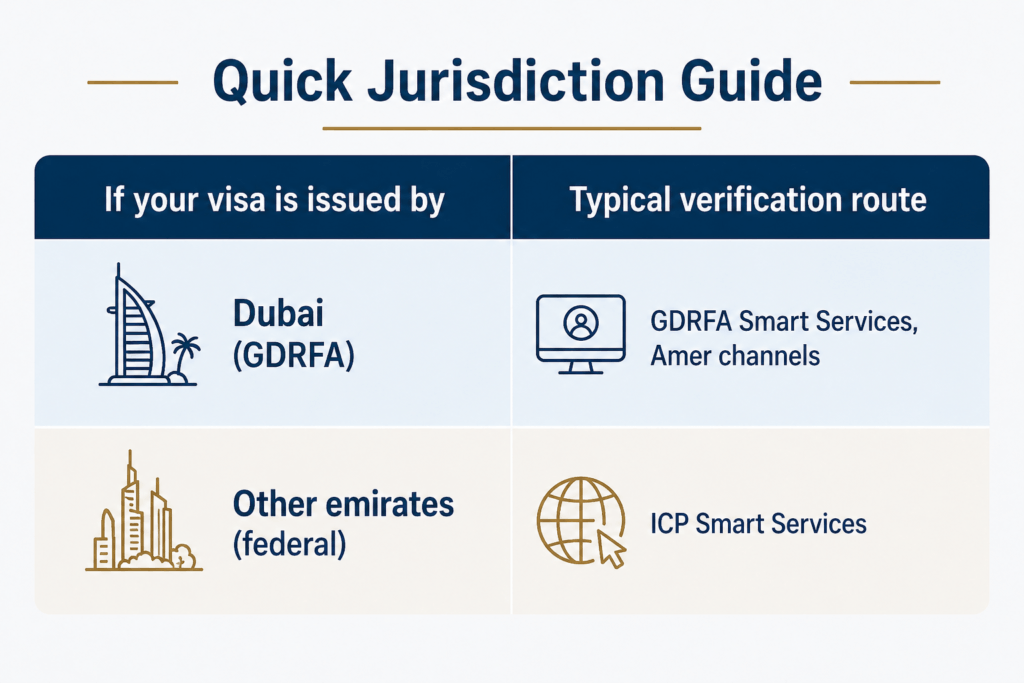
Dubai visas: verify via GDRFA channels
Dubai residence visas are typically verified through GDRFA. Arabian Business Centre has a practical walkthrough on how to verify your GDRFA visa status in Dubai, including common status messages and fixes.
Other emirates: verify via ICP
If your visa was issued outside Dubai (or your file is managed under federal channels), you may need ICP tools instead. If you are uncertain, an authorised typing center in Dubai can help identify the correct jurisdiction before you submit amendments.
Practical travel tips when there is no “residence stamp” in your passport
Most travel problems happen because travelers expect a stamp to be the only proof.
Here is what works in real life (especially at airline check-in desks):
- Keep a saved PDF copy of your visa approval or residence issuance page on your phone, and email.
- Carry your Emirates ID once issued (or at least have the number and a digital copy).
- If you renewed your passport recently, carry the old passport if it contains older UAE stamps or visas that help explain your record.
- Use official status checks when you are unsure. If needed, print a one-page confirmation from the portal.
If your Emirates ID is still in progress, Arabian Business Centre’s resources on Emirates ID application forms and common mistakes and Emirates ID application status support can help you understand what you should see at each step.
Common misunderstandings that cause delays
The move to digital residency reduced paperwork, but it also created new error patterns. These are the issues that most often slow down “stamping” completion.
Mixing up the order of steps
For most residence visas, you still need the full sequence (entry permit or status change, medical fitness, biometrics, then final issuance). Skipping or delaying one step can keep your visa “pending,” even if you assume it is done.
Name and passport mismatches across systems
A single mismatch can block issuance or trigger manual review. Common examples include:
- Different spelling between passport and application
- First name and last name swapped
- Passport renewed but old passport number still used in a transaction
Confusing Emirates ID validity with visa validity
Your Emirates ID is closely linked to your residence status, but they are not the same document. You should always track the residence visa status and not rely only on the ID card date.
For renewal timing in Dubai, you can reference the GDRFA visa renewal guide for UAE residents.
How a typing center in Dubai can help (especially if you need clarity fast)
If your main concern is “Do I still need a passport stamp?”, what you usually need is a fast, accurate answer on:
- Which authority is handling your file (GDRFA/Amer vs ICP)
- What your current status shows in the system
- Whether your case is ready for issuance, or blocked by a mismatch
An authorised typing center in Dubai can be especially useful when you are short on time, managing family files, or handling business-sponsored visas.
At Arabian Business Centre, clients typically use support for:
- Amer services for Dubai residency and visa transactions
- Document checking and correct data entry (to reduce rejections)
- Submission, follow-up, and online application tracking
- Add-on assistance like document translation/attestation where required
If your situation is time-sensitive or involves multiple linked steps (medical, Emirates ID typing, residence issuance), getting an end-to-end review can prevent repeat visits and avoidable delays.
- Most Dubai residence visa cases no longer require a physical passport stamp as the primary proof of residency.
- You should expect digital visa issuance plus the Emirates ID as your everyday residency proof.
- You may still see entry/exit stamps, and in limited exception cases the authority may request your original passport for verification.
If you want to confirm your status the right way, start with a GDRFA visa status verification and keep your digital visa PDFs organized. For people who prefer assisted handling, contact us. Arabian Business Centre can help submit and track the full process through authorised channels.