
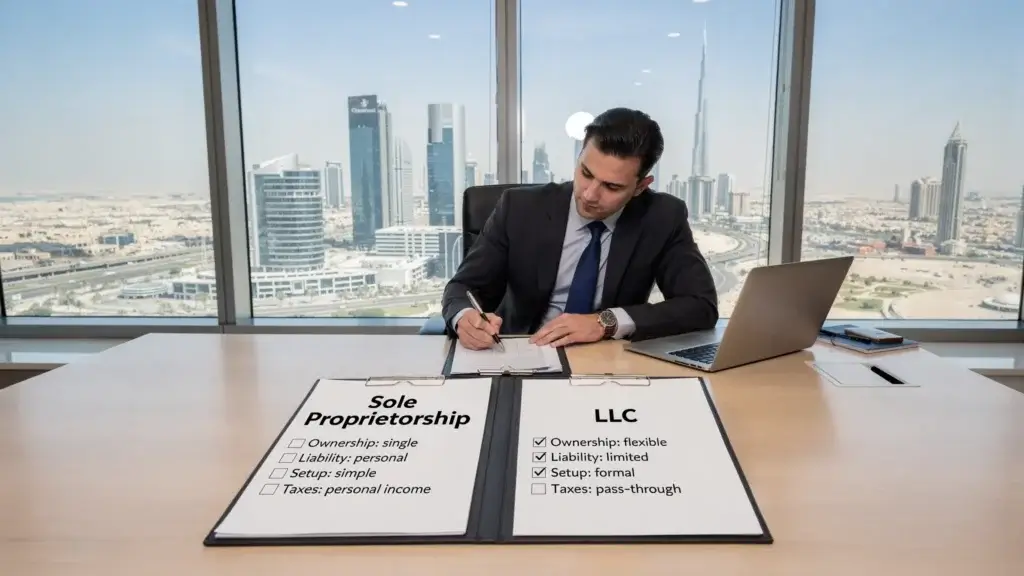
Sole proprietorship vs LLC means comparing a business owned by one individual with a limited liability company that can stand as a separate business entity. In simple terms, the first keeps the owner and the business closely connected while the second creates a clearer line between the company and its shareholders.
For UAE entrepreneurs, the sole proprietorship vs LLC decision affects liability, licensing, visas, banking and long-term expansion. This article looks at the choice from a practical Dubai and UAE setup perspective: what each structure allows, where each can create risk and how government approvals may differ. It also explains why many founders compare LLC and sole proprietorship options before they approach DET, free zone authorities or a professional typing partner.
Some founders search for sole proprietorship LLC because they want one-owner control with LLC-style protection, but UAE legal forms depend on the selected authority and business activity. The goal here is to help you choose a structure that fits your activity, risk level and growth plans without overcomplicating the process.
Sole proprietorship vs LLC in UAE at a glance
A quick side-by-side view makes the sole proprietorship vs LLC discussion easier to understand. The best option depends on your activity, ownership plan, liability comfort and whether you want to scale with partners, employees or multiple branches.
| Factor | Sole Proprietorship in UAE | LLC in UAE |
|---|---|---|
| Legal identity | Closely linked to the individual owner | Separate legal identity in most cases |
| Ownership | One individual owner | One or more shareholders depending on jurisdiction and structure |
| Liability | Owner may carry personal responsibility for obligations | Liability is generally limited to the company shareholding, subject to legal exceptions |
| Best fit | Professional, consultancy and individual service activities | Trading, commercial, service and scalable business models |
| Banking perception | Can work for simple operations with clear documentation | Often preferred for corporate contracts and multi-party operations |
| Visa and hiring scope | Depends on activity, establishment file and authority rules | Often more flexible for teams, partners and future expansion |
| Growth potential | Best for owner-led businesses | Stronger for scaling, investors, contracts and branches |
What a sole proprietorship means in the UAE
A sole proprietorship, also called a sole establishment in some UAE licensing contexts, is a business owned by one individual. It is commonly used for professional services, consultancy work, small service activities and owner-led operations where the founder wants direct control.
From a sole proprietorship vs LLC perspective, this structure is usually about simplicity and personal management. The owner makes decisions directly and keeps the business model lean. For many consultants, trainers, designers, small service providers and solo professionals, that direct structure can be practical.
The key caution is liability. Because the business is closely tied to the owner, personal responsibility may arise for debts, claims or contractual obligations. This is why the activity type and risk exposure matter before choosing this route.
If you are exploring Business set up in UAE, a sole proprietorship may be worth considering when your business is low-risk, service-based and not dependent on external investors. However, it should not be chosen only because it looks simpler at the start.
What an LLC means in the UAE
An LLC, or limited liability company, is a company structure that separates the business from its shareholders more clearly than a sole proprietorship. It is widely used for trading, contracting, service businesses, commercial activities and companies planning to hire employees or deal with larger clients.
The term sole proprietorship LLC can be misleading. A sole proprietorship and an LLC are different legal structures, although some UAE jurisdictions may offer single-shareholder company options or free zone company types that allow one owner. The exact label depends on whether you choose mainland Dubai, another emirate or a free zone.
From a sole proprietorship vs LLC angle, the LLC generally creates stronger separation between personal assets and company obligations. This does not mean shareholders can ignore compliance, contracts or legal duties. Personal guarantees, misconduct or regulatory violations can still create risk.
If you are Setting up a business in dubai, the LLC route is often more suitable when you plan to trade, grow a team, work with corporate clients, add partners or expand beyond a single-person operation.

Key differences that matter before you choose
Liability and legal protection
When people compare sole proprietorship vs LLC, liability is usually the first issue. In a sole proprietorship, the owner and business are closely connected, so obligations may fall directly on the owner. In an LLC, the company structure usually limits shareholder exposure to their stake in the company, subject to applicable laws and exceptions.
This difference matters if your business signs supplier contracts, hires staff, leases premises, imports goods or provides services that could lead to claims. A low-risk advisory business has a different exposure profile from a general trading company or a technical services provider.
Ownership and decision-making
A sole proprietorship is straightforward because one person owns and controls the business. That can be helpful when speed and independence matter. There are no shareholder discussions, profit-sharing arrangements or partner approvals to manage.
LLC and sole proprietorship structures can both support owner-led businesses, but an LLC gives more room for shared ownership. If you expect partners, investors or family members to join later, an LLC may be more practical because it is built for shareholding changes and governance documents.
Business activity and licensing route
The best answer to sole proprietorship vs LLC may change based on your selected business activity. Some professional activities may be suited to sole establishment models, while trading or commercial activities may point naturally toward an LLC or a free zone company.
In Dubai mainland, the Department of Economy and Tourism, often called DET, is central to trade licensing. Free zones have their own authorities and may use different company labels such as FZE, FZ-LLC or branch. Some regulated activities also need external approvals from sector authorities before the license can be issued.
Visas, banking and credibility
For many expatriate founders, sole proprietorship vs LLC is also a visa and banking decision. Both structures may support residence visa and establishment file processes depending on the license, authority and eligibility rules. However, the available visa allocation and hiring capacity can vary by jurisdiction, office arrangement and activity.
Banks may also assess the structure differently during corporate account onboarding. An LLC can appear more suitable for companies with multiple contracts, suppliers, invoices and employees. A sole proprietorship can still work well when records are clear and the activity matches the account purpose.
Compliance and growth
LLC and sole proprietorship setups both require accurate records, renewals and authority approvals. The difference is that an LLC usually carries more formal governance and documentation requirements, especially when there is more than one shareholder.
If your long-term plan includes branches, larger contracts, hiring, investor discussions or brand expansion, the LLC structure often gives more room to grow. If your plan is to remain a solo service provider, a sole proprietorship may be enough.
Which structure fits your business goal?
Use this sole proprietorship vs LLC matrix as a practical decision guide. It is not a substitute for legal advice, but it can help you identify the direction that fits your situation before submitting applications.
| Your Business Situation | Better Fit to Consider | Why It May Fit |
|---|---|---|
| You are a solo consultant offering low-risk services | Sole proprietorship | Direct control and simple ownership structure |
| You want to trade goods or sign supplier contracts | LLC | Better suited to commercial activity and corporate dealings |
| You plan to add partners later | LLC | Easier to structure shareholding and governance |
| You want a personal brand-led service business | Sole proprietorship | Good match for individual professional activities |
| You need a stronger corporate image for tenders | LLC | Often more accepted for corporate contracts |
| You want to hire a team and scale operations | LLC | More flexible for growth and internal structure |
| You are unsure which activity code applies | Professional review recommended | Activity classification affects the legal form |
Dubai mainland, free zone and licensing route
Your licensing jurisdiction can be just as important as the legal structure. Dubai mainland can be attractive for companies that want to trade directly in the UAE market, work with local clients and operate with wider commercial flexibility. Free zones can be attractive for specific sectors, international trade, digital businesses and activities linked to a particular zone ecosystem.
The sole proprietorship vs LLC decision should come after you confirm your activity, target market, ownership plan and license authority. Choosing the structure first can lead to unnecessary amendments if the authority later classifies your activity differently.
Professional Business set up services can help you review activity codes, trade name rules, initial approvals, tenancy or office requirements and visa pathways. This is especially useful when your business activity overlaps more than one category or needs external clearance.
LLC and sole proprietorship applications can both require careful data entry. Name spellings, passport details, Emirates ID records, visa status and business activity codes must match across systems. Small errors can delay approvals, banking and visa processing.
Documents and compliance checkpoints before applying
Before either structure is filed, prepare a clean document set. Requirements vary by authority and activity, but entrepreneurs commonly need identity documents, passport copies, visa or entry status details, proposed trade names, activity selections and proof of business address where required.
A reliable Typing Centre in Dubai can help reduce rejections caused by incorrect form entries or mismatched personal details. For business owners who also need residency, Emirates ID typing, Amer services, Tasheel support or document attestation, coordinating these steps through one support channel can make the setup smoother.
Common checkpoints include:
- Confirming the correct business activity before reserving a trade name
- Checking whether the activity allows sole ownership, an LLC or a specific free zone structure
- Reviewing whether external approval is needed from a sector regulator
- Preparing passport, visa, Emirates ID and contact details exactly as they appear in official records
- Aligning the license structure with future visa, banking and hiring needs
- Keeping copies of all approvals, receipts and application references
The practical value of a licensed typing center is accuracy. Business setup and visa transactions often move through connected government systems, so one mistake in an early record can affect later approvals.
If your regional plan later includes Company formation in saudi Arabia, keep in mind that each country has its own licensing rules, ownership structures and labour requirements. A structure that fits Dubai may not automatically fit Saudi Arabia.
Common mistakes when comparing both structures
The first mistake is treating the sole proprietorship vs LLC question as only an ownership issue. Ownership matters, but liability, activity approval, hiring plans, banking needs and long-term goals matter just as much.
Another mistake is using the phrase sole proprietorship LLC as if it were one standard UAE structure. In practice, you must confirm the official legal form available under the relevant authority. A single-owner company option in one jurisdiction may not be the same as a sole proprietorship in another.
Founders also sometimes choose the easiest-looking route before checking whether their activity needs an LLC, external approval or a particular license category. This can create amendments later. It is better to confirm the correct activity and legal form before submitting the application.
A final mistake is separating business setup from residency planning. If you need investor visas, employee visas, family sponsorship, Emirates ID processing or bank onboarding, the structure should support those next steps from the beginning.
How Arabian Business Centre supports your setup decision
The Arabian business center team at Arabian Business Centre supports entrepreneurs with government transactions, trade license assistance, visa processing, residency services, document typing, attestation coordination and online application tracking. As a Typing Centre in Dubai, it works with key UAE service channels including Amer, DET and Tasheel to help residents and business owners move through formalities with fewer delays.
If you are still weighing LLC and sole proprietorship requirements, a document and activity review can help you avoid choosing the wrong structure. Arabian Business Centre can assist with application preparation, authority routing, business setup documentation, PRO-related support and follow-up for connected visa or residency transactions.
choose the structure that fits your real business plan
Choosing between these structures is not about which one sounds simpler. A sole proprietorship can suit individual professionals who want direct control, while an LLC is often stronger for liability protection, commercial activity, partners, hiring and expansion. The right choice depends on your business activity, risk level, visa needs, banking goals and future growth plan.
If you want your setup reviewed before submission, contact us and let Arabian Business Centre guide you through the right licensing and documentation path. If you face any difficulty in traveling or managing your visa process, Arabian Business Center is here to assist you seamlessly through our convenient online support services. The main message is simple: make the sole proprietorship vs LLC decision before you apply, not after you face a correction, rejection or amendment.
Frequently Asked Questions
The main difference is legal separation and liability. A sole proprietorship is closely tied to the individual owner, while an LLC usually creates a separate company identity with liability limited by shareholding, subject to legal exceptions.
No. The phrase can be confusing because a sole proprietorship and an LLC are different structures. Some jurisdictions may allow single-owner company structures, but the official legal form must be confirmed with the relevant licensing authority.
In many cases, changing structure is possible, but it can involve license amendments, approvals, document updates, banking changes and visa file adjustments. It is better to choose the right structure before the first application.
A sole proprietorship can be easier for a solo professional with a low-risk service activity. An LLC may be better if the entrepreneur plans to trade, hire, add partners or build a larger operation.
No structure guarantees approval. Visa and bank account outcomes depend on the authority, activity, documentation, compliance history, office arrangements and the bank or government review process.