
Mainland company formation in Dubai is the process of registering a business directly with the Dubai Department of Economic Development (DED) instead of through a free zone authority. A mainland license lets a company trade anywhere in the UAE, work with government entities and serve clients across the local market without restriction.
This setup route has become a popular choice among entrepreneurs who want direct access to UAE-based customers alongside the option to expand internationally. Reforms allowing full foreign ownership across most business activities have also made the process more straightforward for international investors and first-time founders.
This article walks through the legal structures, license categories, registration steps and paperwork involved in mainland company setup in Dubai, giving business owners a clear picture of what to expect before they start the registration process.
What Is a Mainland Company in Dubai?
A mainland company is a business entity licensed by the Department of Economic Development in the emirate where it operates. Unlike free zone entities that are largely restricted to operating within their designated zone or internationally, mainland businesses can sign contracts with private clients anywhere in the UAE and bid for government tenders.
Company setup in Dubai mainland suits businesses that need a retail presence, a client-facing office or room to expand into other emirates under one license. Eligible activities span professional services, trading, industrial production, tourism and more, each falling under a specific license category.
Benefits of Mainland Company Setup in Dubai
Mainland company setup in Dubai offers several practical advantages compared with other business structures in the UAE.
Full foreign ownership now applies to most commercial and professional activities, removing the earlier requirement for a local Emirati partner in many sectors. Owners can rent office space anywhere in the emirate, sponsor staff and family members for residence visas without a fixed cap and take on projects directly from UAE-based clients and government departments.
Business owners who are still comparing structures often look into setting up a business in Dubai to see how mainland options compare with other available paths before committing to one.
Legal Structures and License Types for Mainland Company Setup
Dubai mainland businesses can register under a few common legal structures depending on the number of owners and the nature of the activity. A Limited Liability Company suits most trading and service businesses with two or more shareholders, while a sole establishment fits single-owner professional or service activities.
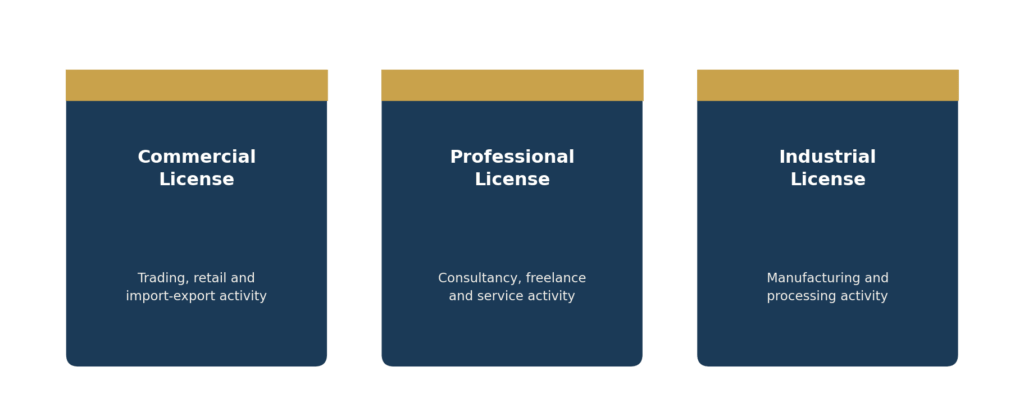
Each structure is then matched with a license category based on the planned business activity. The table below outlines the three main categories issued by the Dubai DED.
| License Type | Best Suited For | Issued By |
|---|---|---|
| Commercial License | Trading, retail and import-export activity | Dubai DED |
| Professional License | Consultancy, freelance and service-based activity | Dubai DED |
| Industrial License | Manufacturing and processing activity | Dubai DED |
Process for Mainland Company Formation in Dubai
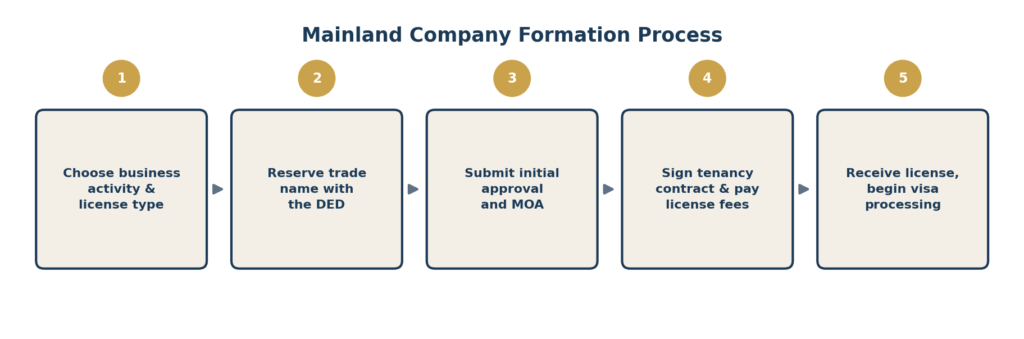
The registration sequence generally follows a consistent order regardless of business activity, though the timeline can shift depending on approvals needed from other authorities.
Start by selecting a business activity and confirming the matching license category, then reserve a trade name that meets DED naming rules. Once the name is approved, submit an application for initial approval along with the Memorandum of Association for multi-shareholder structures. Many founders bring in business set up services at this stage to keep document preparation and submissions moving without delay.
After initial approval, the next steps involve signing a tenancy contract for office space, paying the relevant license fees and completing the establishment card application. A typing center is typically used to format and submit documents in the system used by the DED, after which the license is issued and visa processing can begin for shareholders and staff.
Documents Required for Dubai Mainland Company Setup
Documentation requirements vary slightly between individual shareholders and corporate shareholders, though both routes share a common base of paperwork. Most applicants work with a typing centre in Dubai to ensure forms are completed in the correct format before submission to the DED.
| Document | Individual Shareholder | Corporate Shareholder |
|---|---|---|
| Passport copy | Required | Required for UBO and manager |
| Trade name reservation certificate | Required | Required |
| Initial approval certificate | Required | Required |
| MOA or Local Service Agent Agreement | Required for multi-shareholder structures | Required |
| Tenancy contract for office space | Required | Required |
| Board resolution appointing a manager | Not applicable | Required |
Mainland vs Free Zone: Which Setup Fits Your Business
Mainland and free zone companies serve different business goals. The right choice depends largely on where the company plans to operate.
Mainland businesses can trade directly across the UAE without restriction, while free zone companies generally need a local distributor or additional approval to sell within the mainland market. A detailed breakdown of UAE mainland vs freezone options covers ownership rules, office requirements and market access in more depth for businesses still weighing both paths.
Compliance and Ongoing Requirements
Once a mainland company is registered, a few ongoing obligations come into play. Businesses that cross the applicable revenue threshold must register for VAT, while corporate tax filing applies to companies whose taxable profits exceed the threshold set by UAE tax law, with relief available for smaller businesses.
License renewal, visa renewals for staff and updates to the trade license whenever business activity changes are also part of staying compliant. This ongoing side of business setup in UAE is worth planning for early, since missed renewals can affect a company’s ability to operate smoothly.
Conclusion
Mainland company formation in Dubai gives business owners a flexible route into the UAE market, with full ownership in most sectors, unrestricted trading and access to government contracts. The process involves a handful of clear steps, from choosing the right license category to submitting documents and securing the trade license. Getting each stage right from the start helps avoid delays later on.
Working with a specialist team such as Arabian Business Center takes the guesswork out of choosing a structure, preparing documents and liaising with government departments. If you are ready to register your business or simply want clarity on the right setup for your goals, contact us and our team will walk you through the next steps.
Frequently Asked Questions
A mainland company allows full ownership in most sectors, unrestricted trading across the UAE and eligibility for government contracts. It also permits operating from any location in the emirate without zone restrictions.
Yes, a free zone company can be converted into a mainland entity through a formal license transfer process with the Department of Economic Development. The business must cancel its existing free zone license and re-register under mainland regulations before continuing operations.
The certificate of incorporation, often referred to as the trade license, is the official document confirming a company’s legal registration with the Dubai DED. It states the company name, activity, legal structure and license validity.
An LLC registered under UAE mainland rules requires at least two shareholders, an approved trade name and a Memorandum of Association outlining ownership shares. Most business activities now allow full foreign ownership without a local Emirati partner.
The pros include unrestricted market access, no currency or trading limits and visa flexibility, while the cons include the mandatory physical office requirement and slightly more compliance obligations than a free zone setup. Choosing between the two depends largely on whether the business plans to serve UAE-based clients directly.