
A divorce certificate is one of those documents you rarely think about until you urgently need it for a new marriage, child-related paperwork, or a UAE visa application. In the UAE, a divorce document issued abroad usually cannot be used “as-is”. It must be legalized (attested) and, in most cases, translated into Arabic by a certified legal translator.
This guide explains how divorce certificate attestation works in the UAE, what steps you should expect, and how to avoid the most common delays.
What “attestation” means for a divorce certificate in the UAE
In UAE practice, attestation (sometimes called legalization) is the process of verifying that:
- The document is genuine.
- The signature and seal on the document are authentic.
- The document is acceptable for official use in the UAE.
For most foreign-issued divorce certificates, attestation is a multi-authority chain that typically ends with the UAE Ministry of Foreign Affairs and International Cooperation (MOFAIC).
Important: The exact chain depends on where your divorce certificate was issued and which authority will receive it in the UAE (court, immigration, embassy, school, bank, etc.). When in doubt, confirm the requirement before you start.
When you usually need a divorce certificate attested in the UAE
People typically attest a divorce certificate for:
- Remarriage in the UAE (or updating marital status records)
- Family visa applications (in some scenarios involving dependents, sponsorship history, custody, or status updates)
- Child custody or guardianship-related processes
- Court submissions
- Updating records with institutions (schools, insurance, banking compliance checks)
If your divorce was finalized outside the UAE, most UAE entities will request an attested document, and many will also request certified Arabic translation.
Foreign-issued vs UAE-issued divorce certificates: the process is different
Before you start, identify which of these applies to you.
| Type of Divorce Document | Typical Examples | What the UAE Usually Requires |
|---|---|---|
| Foreign-issued divorce certificate or decree | Divorce certificate, decree absolute, final judgment, dissolution certificate | Home-country authentication, UAE Embassy or Consulate legalization, then MOFAIC attestation in the UAE (plus Arabic translation in many cases) |
| UAE-issued divorce certificate | Dubai Courts or other emirate court documents | Usually no embassy legalization, but you may need MOFAIC attestation for use outside the UAE, or certified copies and Arabic legal formatting depending on the use case |
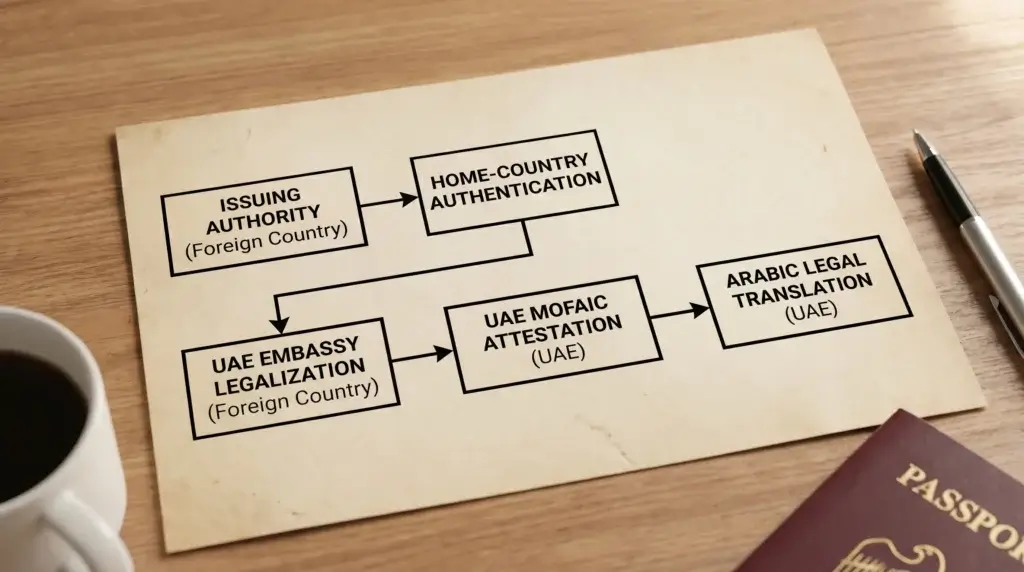
This article focuses mainly on foreign-issued divorce certificate attestation for use inside the UAE, which is the most common expat scenario.
Step-by-step: How to attest a divorce certificate for use in the UAE (foreign-issued)
While exact steps vary by country, the standard workflow usually looks like this.
1) Make sure you have the correct document version
UAE authorities usually expect the final divorce document (not a filing, not a hearing notice). Depending on your country, the acceptable document may be called:
- Divorce certificate
- Decree absolute
- Final judgment
- Dissolution decree
If you are unsure, confirm what your issuing country provides as the final divorce proof.
2) Check whether you need notarization first
Some countries require a document to be notarized (or issued as a certified true copy) before it can be authenticated by government departments.
Common situations where notarization is needed:
- The divorce document is a copy, not an original.
- The divorce proof is an electronically issued document that must be certified.
- The document must be converted into a notarized affidavit format (less common for divorce, but can happen in edge cases).
3) Authenticate the document in the country of issue
This step confirms the document at the local or national level in the issuing country. Depending on the country, it may involve:
- A state-level authentication office
- A foreign ministry (or equivalent)
- A national legalization department
At the end of this stage, your divorce certificate becomes eligible for UAE consular legalization.
4) Legalize the document at the UAE Embassy or Consulate (in the issuing country)
For many foreign documents, the UAE Embassy or Consulate in the issuing country stamps/legalizes the document after home-country authentication is complete.
This step is crucial because MOFAIC in the UAE typically expects the document to already carry UAE consular legalization for foreign-issued certificates.
5) Attest the document at MOFAIC in the UAE
Once the document reaches the UAE with the required overseas stamps, the final legalization step for UAE use is usually MOFAIC attestation.
You can learn more about the UAE MOFA process here: How to attest documents from MOFA.
For official information, you can also refer to the MOFAIC website.
6) Complete certified Arabic translation (often required)
Even when the attestation stamps are complete, many UAE entities will still require an Arabic legal translation.
Practical guidance that often helps avoid rejections:
- Translate only after you have the final document version.
- Ensure names match passports and UAE records.
- Use a certified legal translator for UAE submissions.
A similar rule applies to other personal status documents. For example, Dubai family visa processes commonly require Arabic translation and proper attestation for marriage certificates, and divorce documents are often treated with similar strictness.
If you want a reference point for how UAE authorities handle translation requirements, see: Is Arabic translated marriage certificate required for a family visa in Dubai?.
Special cases that can change the requirements
If your divorce certificate is from a Hague Apostille Convention country
Some countries issue an apostille for international document recognition. However, UAE acceptance rules depend on the document type, the receiving authority, and current legalization practice.
If you are unsure whether an apostille alone is enough for your specific case, treat it as a “verify first” scenario. Many UAE processes still require MOFAIC attestation as the final step.
For clarity on how apostille and UAE legalization differ, see: Apostille vs MOFA Attestation: Which One Do You Need for Your Documents?
If the divorce document includes multiple pages, attachments, or court orders
Some divorce decrees include:
- A judgment plus annexures
- Custody or support orders
- A settlement agreement
In such cases, authorities may require:
- All pages attested together
- Specific pages translated
- Additional supporting documents (case dependent)
If your name changed after divorce
If your passport name does not match the divorce certificate, you may need supporting evidence (for example, a name change document or an affidavit, depending on your nationality and the UAE authority involved).
Documents you should prepare (common checklist)
Exact requirements vary, but these are commonly requested when you submit a divorce certificate for attestation/translation support:
- Clear scan of the divorce certificate/decree (all pages)
- Passport copy of the document holder
- UAE visa page or Emirates ID copy (if you are a UAE resident)
- Any supporting proof for name variations (if applicable)
- Contact details and the purpose of attestation (where you will use it)
Tip: Keep both PDF scans and clear photos. Low-quality scans are a frequent reason for delays.
Common reasons divorce certificate attestation gets delayed (and how to avoid them)
Most delays are preventable if you handle these early.
Data mismatch across documents
Examples:
- Spelling differences between divorce document and passport
- Missing middle name
- Different date formats that create confusion
Fix: Standardize your spelling across submissions and request supporting letters/affidavits if needed.
Using an incomplete divorce document
A “divorce filing” or interim document is often not accepted where a final decree is required.
Fix: Confirm the document is the final divorce proof before starting legalization.
Laminated documents
Some authorities will refuse to stamp or authenticate laminated originals.
Fix: Do not laminate official documents you plan to legalize.
Translation done too early or by a non-certified translator
Fix: Use certified legal translation intended for UAE use, and time it correctly.
How long does divorce certificate attestation take in the UAE?
Timelines depend heavily on:
- The issuing country’s authentication steps
- UAE Embassy or Consulate processing time in that country
- Courier movement (if you are handling it from the UAE)
- Whether translation is required, and if corrections are needed
In practice, it can take anywhere from several business days to several weeks end-to-end for foreign-issued documents.
If you have a deadline (for example, remarriage paperwork or a court submission), start early and avoid last-minute submissions before public holidays.
Where to attest a divorce certificate in Dubai
You typically have three options:
- Do it yourself by coordinating the full chain (issuing country authentication, UAE Embassy/Consulate, then MOFAIC in the UAE)
- Use official portals and book services directly where available (varies by step)
- Use an authorized typing and government transaction center to coordinate the process, especially when translation, MOFAIC, and submission accuracy matter
If you are already using a service center for other government processes, it can be efficient to bundle tasks like document translation, MOFAIC attestation, and related applications.
For broader context on attestation workflows in Dubai, see: Everything You Need to Know About Certificate Attestation.
Practical tips before you submit your divorce certificate for UAE use
These quick checks save time:
- Confirm whether the receiving entity wants original attestation stamps or accepts a stamped copy.
- Ask whether Arabic translation is mandatory for your specific use.
- Ensure the divorce certificate is the final version and includes all required pages.
- Keep your passport and UAE ID copies consistent and clear.
- If your document has a QR code or reference number, do not obscure it in scans.
Need help attesting a divorce certificate in Dubai?
If you want to avoid rejections, delays, and repeated visits, Arabian Business Centre can help coordinate your divorce certificate attestation for UAE use, including document review, certified translation, and MOFAIC processing. You can also take advantage of free document pick-up and delivery, online application and tracking, and transparent, no-hidden-fee support.
Get started here: Arabian Business Centre or contact the team through the website to confirm the exact requirement chain for your issuing country and use case.
Frequently Asked Questions
In many cases, yes. For foreign-issued divorce certificates, MOFAIC attestation is commonly the final legalization step before the document can be used officially in the UAE.
Often yes, especially for immigration, court, and other government-facing use cases. Requirements can vary by entity, so confirm before submission.
Some steps require original documents or properly certified copies, depending on the issuing country and the legalization stage. A scan is usually helpful for pre-checking, but it may not replace the required original or certified copy.
This is a common issue. You may need additional supporting documentation (such as a name change document or affidavit) so the UAE authority can link the records correctly.
It depends on the issuing country and the UAE entity requesting the document. Many UAE processes still require UAE legalization steps and MOFAIC attestation. If you are unsure, verify the required route before you start.
Yes. A reliable typing and government transaction center can help with document review, certified translation coordination, MOFAIC attestation processing, and reducing errors that cause rejections.